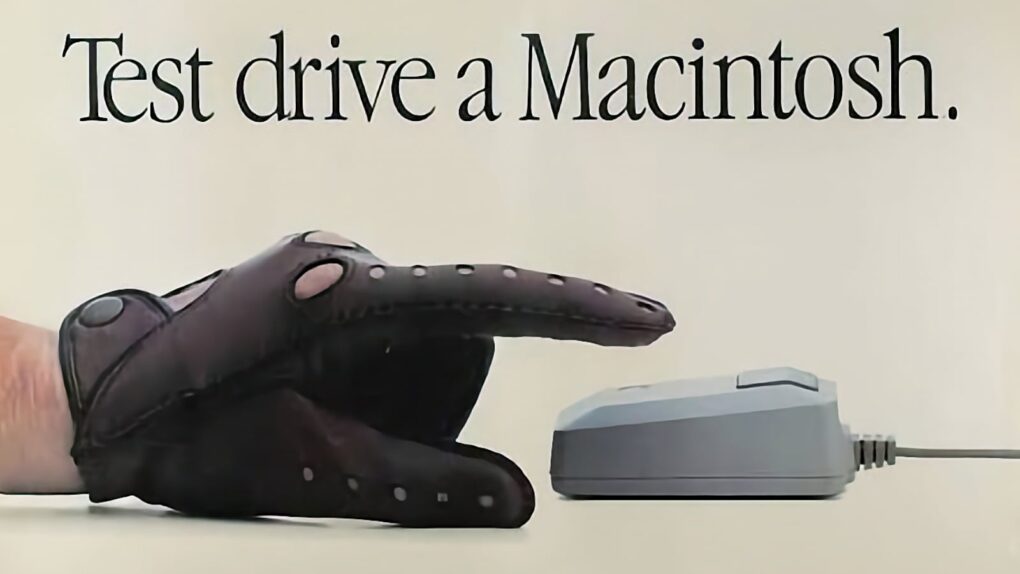
 November 8, 1984: After initial Mac sales prove disappointing, Apple CEO John Sculley dreams up the “Test Drive a Macintosh” marketing campaign to encourage people to give the revolutionary new computer a chance.
The promotional strategy advises people to drop into their local retailer and “borrow” a Macintosh for 24 hours. The idea is that, by the time potential customers need to return the Mac, they will have bonded with it — and realized they can’t live without one of Apple’s computers.
While 200,000 would-be customers take advantage of the offer, Apple dealers absolutely hate the innovative promotion.
Goodbye, 1984: Apple’s ‘Test Drive a Macintosh’ promo
In late 1984, Apple didn’t just need people to buy the Macintosh. It needed them to understand why they should want one. The graphical user interface, mouse and point-and-click simplicity represented a radical departure from the computers most people knew. And no glossy ad alone could fully convey what it felt like to use one.
So Apple tried something audacious: a promotional campaign that let strangers take a Mac home for 24 hours and fall in love with it. John Sculley‘s car-inspired marketing gambit put potential customers behind the wheel of a Mac, turning a computer purchase into an emotional experience.
Sculley dreamed up the Test Drive a Macintosh campaign to help skeptical users wrap their heads around Apple’s revolutionary new machine, which launched at the beginning of the year. Many of them had never seen a GUI, used a mouse or worked with non-IBM computers.
Several memorable TV commercials accompanied the Test Drive a Macintosh campaign. One, which you can watch below, showed what appeared to be the outline of a high-end sports car obscured by a dust cover.
“It’s powerful,” purrs the narrator with fetishistic admiration, as the camera takes in the curves and smooth edges hidden beneath the sheet. “It’s responsive. It handles beautifully. And it’ll blow the doors off anything else in its class.”
At that point, the cover gets whisked away — and the big reveal is that the narrator isn’t talking about a sleek Ferrari or Mercedes. Instead, we see a mouse connected to a Mac.
The campaign was pure Sculley: more optimistic and less bleak than Apple’s memorable “1984 dystopian future” Mac ad. Instead, it featured a fun, high-concept hook.
Apple pitches the computer as a status symbol
At his previous job as president of PepsiCo, Sculley concocted the legendary Pepsi Challenge campaign, which asked customers to take part in a fun experiment — a blind taste test of Pepsi versus Coca-Cola. The Test Drive a Macintosh stunt offered more of the same, giving potential buyers a chance to put the computer through its paces just like when test-driving a car.
“Automobiles were bought for emotional reasons as much as any practical reason,” Sculley told me when I was writing my book The Apple Revolution. Apple wanted to tap into this “emotional reason.”
After all, cars were Americana. They were status symbols. They made your life easier and more comfortable.
“The idea of test-driving a car itself is not a controversial idea,” former Apple marketing manager Mike Murray told me. “It’s very acceptable behavior, whether you might buy the car or not. A person can go into a dealership, whether it’s for a Ferrari or a Ford, and say they’d like to test-drive a particular car. The salesperson would say, ‘Sure, let’s go,’ and you’d hop into the car and go for a ride.
“If we hadn’t used that phrase and instead had created a campaign called ‘Take a Mac Home for a Night,’ no one would have done it,” Murray continued. “It wouldn’t have made any sense at all for somebody to go into a computer store and say, ‘I want to take that computer home for a night.’ There would be no emotional memories or persuasion or feelings. We had to draw on past cognitive experiences, and the test drive of a car was the obvious metaphor.”
Test Drive a Macintosh campaign launches with $2.5 million ad blitz
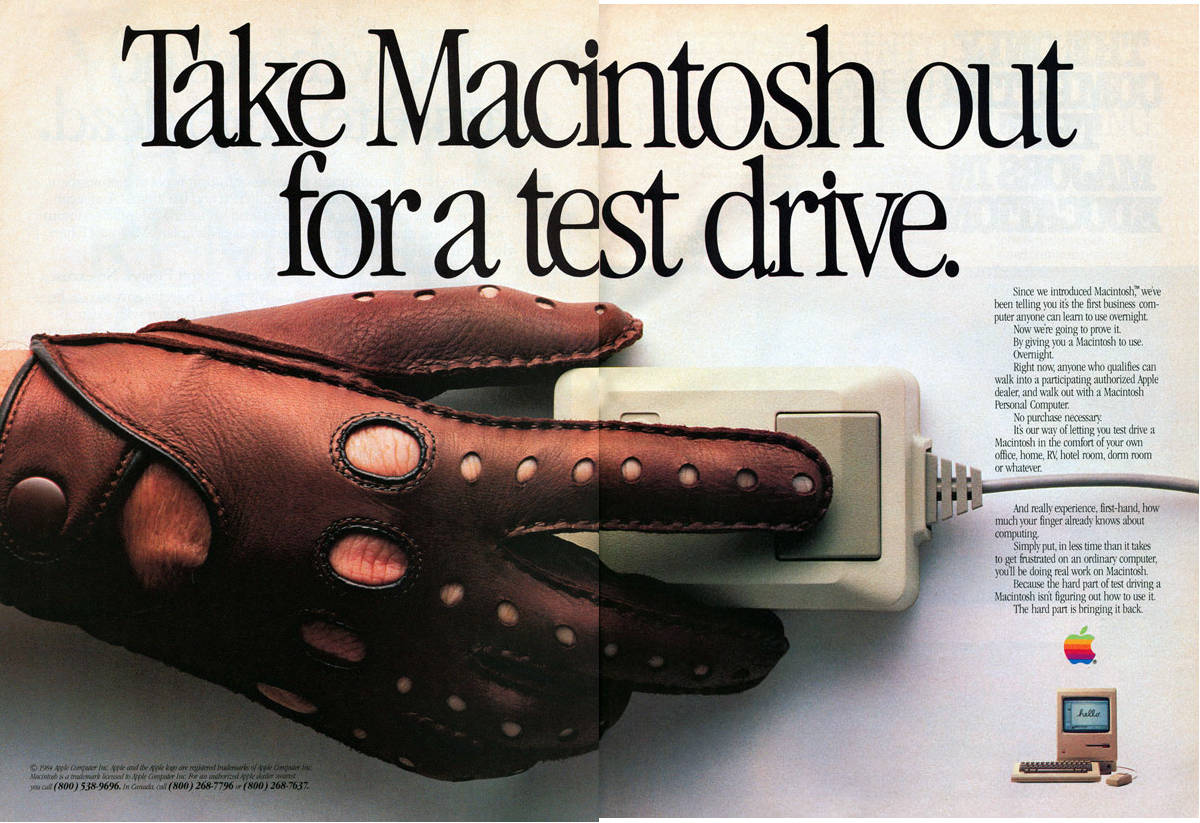
Image: Apple
To launch the campaign, Apple shelled out more than $2.5 million for all 40 pages of advertising in the November 1984 election edition of Newsweek magazine. The final page was a fold-out ad announcing the offer.
“It’s unclear whether Apple has an advertising insert in Newsweek or whether Newsweek has an insert in an Apple brochure,” Sculley quipped in a November 8 interview with the San Francisco Chronicle.
People who took Apple up on the offer received a 16-page booklet and a cassette tape that walked them through the experience. It explained how to use a mouse and offered tips on using MacPaint, MacWrite and other Macintosh software included on floppy disks.
“This book is yours to keep,” the booklet said on Page 1. “But you will have to bring back the disks, the cassette tape, the carrying case, and, alas, the Macintosh.”
Mixed reviews for Sculley’s Test Drive a Macintosh stunt
In the end, the campaign met with mixed reviews. Around 200,000 customers took advantage of the computer test-drive offer. I’ve spoken with Apple fans who got their first taste of the Mac by plunking down a credit card and taking one home for 24 hours — only to fall in love and never buy a computer made by another company again.
On the other end of the spectrum, computer dealers hated the campaign. Macs were already in short supply. And loaning them out meant lots of paperwork for no guaranteed sale. It also ensured that Macs might not actually be available in stores when real customers came along to buy one.
In addition, many testers returned the Macs in slightly worse condition than when loaned. The damage, while typically not bad enough to charge the shopper, still could be noticeable.
Apple never again ran a test-drive campaign like this, although the company’s two-week “no questions asked” return policy effectively serves the same purpose. Still, it’s hard to write off this strategy as a total failure — even if it didn’t spur a Mac sales bump.
Do you remember the Test Drive a Macintosh campaign? When did you first try a Mac? Leave your comments below.

Luke Dormehl is a U.K.-based journalist and author, with a background working in documentary film for Channel 4 and the BBC. He is the author of The Apple Revolution and The Formula: How Algorithms Solve All Our Problems … and Create More, both published by Penguin/Random House. His tech writing has also appeared in Wired, Fast Company, Techmeme and other publications.