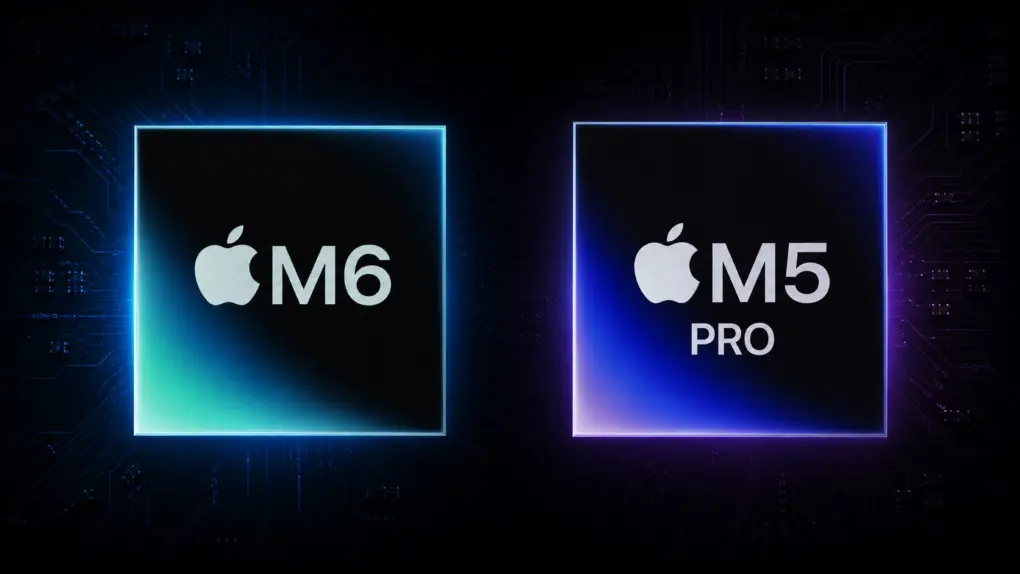
With the latest Mac mini, Apple launched its first 2nm chip: the M6. It stands out for several reasons, including enhanced single-core performance and dual Neural Engines for better AI performance.
But that does not automatically make it better than the M5 Pro, which trumps the M6 in some key areas.
Both are available in the new Mac mini, so it’s up to buyers to choose which is the better option for them. To help with the decision, here’s how the two stack up.
M6 vs. M5 Pro: Which Mac mini chip is better?
The M-series Apple silicon processors typically include a base chip followed by Pro, Max and Ultra variants. M6 is the first in the M6 family to launch, featuring several major architectural changes and improvements. It’s currently available in the 2026 Mac mini, which Apple announced Tuesday, and could make its way into an iMac refresh later this year as well as a new base MacBook Pro.
Yet, for higher-end Mac mini models, Apple sticks to its M5 Pro chip — there’s no M6 Pro in sight. Still, despite being an older chip generation, M5 Pro packs more CPU and GPU cores, supports more unified memory and delivers higher memory bandwidth than the M6.
So, even though M6 carries a higher number, it’s not automatically better than the M5 Pro.
M6 vs. M5 Pro: Specifications
| Specification | M6 | M5 Pro |
|---|---|---|
| Manufacturing process | 2nm | Third-generation 3nm |
| Architecture | Single die | Dual-die Fusion Architecture |
| CPU | 12 cores | 15 or 18 cores |
| CPU configuration | 2 Super, 4 performance and 6 efficiency cores | Up to 6 Super and 12 performance cores |
| GPU | 12 cores | 16 or 20 cores |
| Neural Accelerator | One in every GPU core | One in every GPU core |
| Neural Engine | Dual 16-core Neural Engine | 16-core Neural Engine |
| Unified memory | Up to 32GB | Up to 64GB |
| Memory bandwidth | Up to 170GB/s | 307GB/s |
| Hardware-accelerated ray tracing | Yes | Yes |
| Video decode engines | 1 | 1 |
| Video encode engines | 1 | 1 |
| ProRes encode-and-decode engines | 1 | 1 |
| AV1 decoding | Yes | Yes |
M6 uses Apple’s newest chip architecture and manufacturing process
Apple’s M6 processor stands out for being the first system-on-a-chip (SoC) to use Taiwan Semiconductor Manufacturing Company’s latest 2-nanometer fabrication process. A smaller process node means the chipmaker can pack more transistors into a chip while improving performance and efficiency.
By comparison, M5 Pro uses TSMC’s third-generation 3nm process node.
With M6, Apple offers a 12-core CPU comprising two super cores, four performance cores and six efficiency cores. More importantly, the super cores use an upgraded architecture more advanced than the one found in the M5 Pro.
Apple’s previous base chip, the M5, packs a 10-core CPU. So, with two additional super cores, the M6 should deliver better multicore performance compared to its predecessor. In its press release, Apple says M6 delivers up to 1.2 times faster multithreaded performance than the regular M5.
But the M5 Pro uses Apple’s Fusion Architecture. This connects two separate dies with a high-bandwidth, low-latency link and allows them to function as a single chip. By comparison, M6 uses a more conventional single-die design.
That does not automatically make M5 Pro faster. However, it gives Apple more room to add CPU and GPU cores, memory controllers and other components than the base M6 design offers.
This is why, despite using an older 3nm manufacturing process, M5 Pro offers higher memory bandwidth and supports more unified memory than M6.
M5 Pro has far more CPU firepower
For all the architectural and manufacturing improvements Apple’s M6 chip packs, the M5 Pro offers more CPU horsepower. It comes in 15- and 18-core configurations. The former combines five super cores with 10 performance cores, while the top version packs six super cores and 12 performance cores.
There are no efficiency cores on the Pro chip — these benefit computers that run off batteries but offer little benefit to a Mac mini desktop. Focusing on super and performance cores automatically gives the M5 Pro a performance advantage over the M6 in multicore workloads. So, even though M6 delivers better single-core performance, M5 Pro wins, due to its sheer number of CPU cores and layout.
To be clear, that does not mean M6 is a bad chip. If anything, its excellent single-core performance makes it a great choice for regular use such as web browsing, email, photo editing, etc. And its efficiency cores will be a boon to MacBooks and iPads.
M5 Pro packs a much beefier GPU
Image: Apple
Apple’s new M6 chip includes a 12-core GPU, with a Neural Accelerator in each GPU core. It also supports hardware-accelerated ray tracing and Apple’s Dynamic Caching technology.
This allows for up to twice the performance of the older M4 chip in select workloads, according to Apple. However, the M5 Pro again wins over the M6 with its higher core count. It comes with either 16 or 20 GPU cores.
That additional core count means M5 Pro can deliver significantly better performance in 3D rendering, visual effects and other GPU-intensive tasks.
For AI workloads, M5 Pro’s higher GPU cores and memory bandwidth give it an edge over M6.
Raw performance is only one part of the equation, though. M6’s newer 2nm manufacturing process and six efficiency cores should allow it to handle lighter workloads while consuming less power than M5 Pro.
This does not mean M5 Pro is more power-hungry. Both chips deliver fantastic power efficiency. It’s just that the M6 is geared toward efficiency, while the M5 Pro focuses more heavily on performance. And that becomes obvious when you see that Apple will also eventually offer the M6 inside the iPad Pro and MacBook Air, which lack active cooling systems.
M6’s AI advantage is not as simple as it looks
You can configure the new Mac mini with the M6 chip with up to 32GB of unified memory. It delivers 170GB/s of memory bandwidth.
Meanwhile, the M5 Pro doubles the maximum memory support to 64GB and bumps memory bandwidth to 307GB/s. Theoretically, this means M5 Pro offers 81% more memory bandwidth than M6.
This higher bandwidth ensures the CPU, GPU and Neural Engine can quickly access the shared pool of memory. This makes a big difference for AI and machine learning workloads.
That’s despite M6 coming with dual 16-core Neural Engine cores. Those could help it win some AI-specific tests, but it does not make it a better chip for AI.
In regular use, M6’s lower memory support and bandwidth are not a big concern. But if you are a pro user, the M5 Pro should be your obvious choice.
Similar media engines
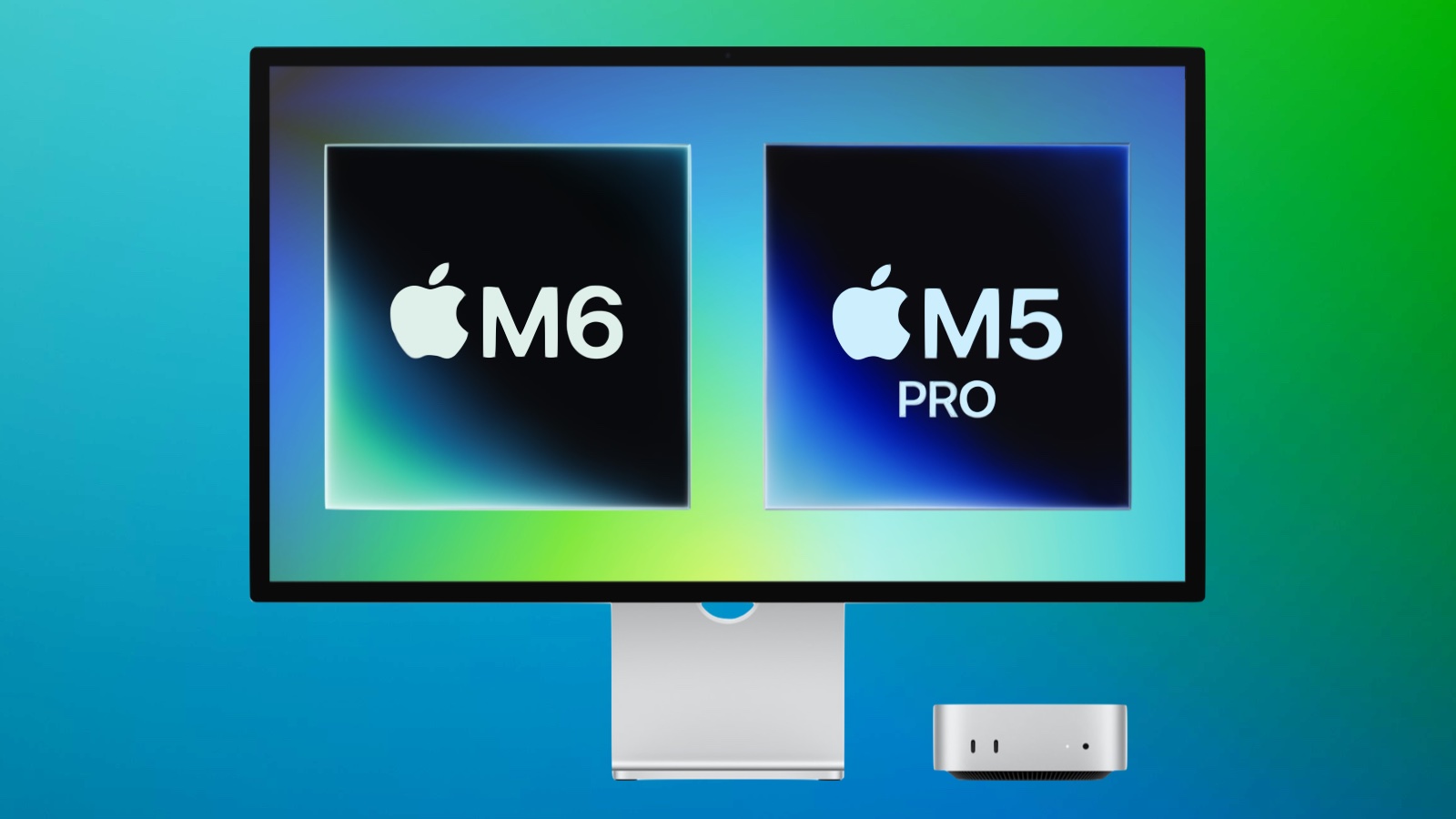
Image: Apple/Cult of Mac
Despite its Pro branding, M5 Pro does not contain more dedicated video engines than M6. Both chips include one video decode engine, one video encode engine and one ProRes encode-and-decode engine. They support hardware acceleration for H.264, HEVC, ProRes and ProRes RAW and AV1 decoding.
Still, M5 Pro should perform better when editing complex timelines because of its additional CPU and GPU cores and higher memory bandwidth.
M6 vs. M5 Pro: Which chip is better?
M6 and M5 Pro target different audiences. They are both great chips, but M5 Pro is more powerful despite the older M5 branding.
M6 excels with its excellent single-core performance and efficiency. It is a great everyday computing chip, ideal for MacBook Air and fine for Mac mini users with less demanding needs.
M5 Pro remains the more powerful chip for sustained professional workloads. It offers up to 18 CPU cores, 20 GPU cores, 64GB of unified memory and 307GB/s of memory bandwidth. Those advantages should make it faster for software compilation, 3D rendering, visual effects, complex video projects and large local AI models.

Rajesh has been writing about consumer technology for over a decade, with a strong focus on iPhones, Macs and Apple’s ecosystem. He enjoys digging into Apple software updates, hardware changes, and discovering new Mac apps that make work faster and more enjoyable.
You can reach out to him at mail[at]rajeshpandey.me.