
Nvidia’s RTX graphics cards — the kind already sitting inside many Windows PCs and workstations — can now stream high-fidelity, immersive content directly to an Apple Vision Pro headset via Nvidia CloudXR. It’s a collaboration the two companies announced Tuesday at Nvidia’s GTC conference in San Jose.
What Nvidia CloudXR for visionOS actually does
The technology at the center of the announcement is Nvidia CloudXR 6.0. It’s a streaming framework that handles the heavy computational lifting of graphically demanding games, simulations and professional 3D applications on a local RTX-powered PC or in the cloud. Then it pipes the rendered output wirelessly to Vision Pro, according to a Nvidia blog post. The headset itself doesn’t need to crunch the numbers — it just displays the results. So this could bring a lot more heavy-duty immersive content to the headset for professional and casual users.
The integration is native to visionOS, with support for foveated streaming. It intelligently optimizes rendering resolution based on approximately where the user is looking, while strictly protecting gaze data from being exposed to applications, according to Nvidia. That last point matters: Apple’s privacy architecture means the app never actually knows where your eyes are pointed. It only receives the optimized stream.
For developers, CloudXR 6.0 is now available as a native streaming framework for Swift, Apple’s programming language for visionOS, iOS, iPadOS and other platforms. Swift developers can stream and build high-fidelity consumer and enterprise apps within Xcode, Apple’s integrated development environment. In practical terms, that means a visionOS developer doesn’t need to build a separate pipeline — CloudXR slots into the toolchain they already use.
The enterprise angle: Automotive, healthcare, aviation
The announcement is heavy on enterprise use cases, and for good reason. This is where the pairing of Vision Pro’s spatial computing and Nvidia’s rendering muscle is most immediately compelling.
Automotive companies including Kia, BMW Group, Rivian and Volvo Group use the integration through Autodesk VRED and Innoactive’s XR streaming solutions to visualize massive 3D models with RTX-powered ray tracing at true 1:1 scale inside Vision Pro. Rather than gathering around a screen or a physical clay model, design teams can essentially walk around a photorealistic, full-size virtual car together.
Pharmaceutical company Roche, working with Innoactive, uses Autodesk Revit software, Nvidia Omniverse libraries and CloudXR for visionOS to simulate lab layouts before construction begins. Manufacturer Foxconn uses the same pipeline for factory-floor walkthroughs, letting designers explore and optimize facilities before they’re built (see the video above).
The common thread is eliminating expensive, late-stage physical prototypes by making digital models feel real enough to evaluate confidently.
What it means for consumers and simulation fans
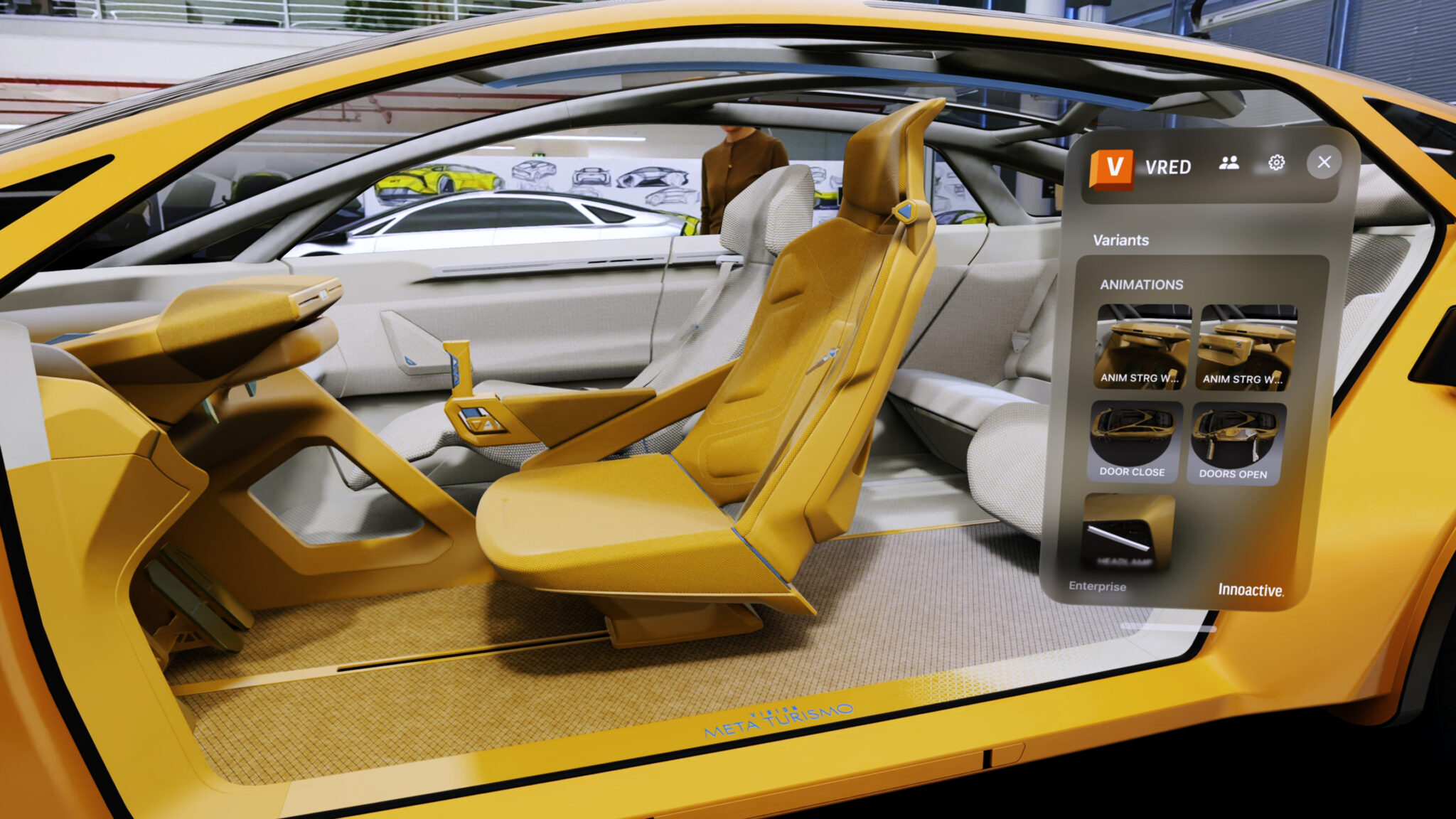
Photo: Apple/Kia
Beyond enterprise workflows, CloudXR for visionOS also lets simulation enthusiasts connect RTX-powered titles like iRacing and X-Plane to Vision Pro. So that enables 4K immersive gaming and flight simulation without compromise. If you’ve already invested in a high-end Nvidia GPU for a gaming or sim rig, Vision Pro can now plug into that investment rather than demanding a separate, self-contained experience.
That’s a meaningful shift in how the headset can be positioned. Vision Pro has sometimes struggled against the perception that it’s a standalone device limited to whatever its onboard chip can handle. CloudXR reframes it as a display and interaction layer for much more powerful hardware.
The privacy piece
One recurring theme in Nvidia’s and Apple’s framing is that gaze data — the information about exactly where a user’s eyes are focused, which is what enables foveated streaming to work — is never exposed to the application layer. Approximate gaze data is processed on-device by visionOS to optimize the stream. But it is never passed to the application itself. That protects user privacy while maintaining the ultralow latency required for comfortable, photorealistic immersion.
For enterprise deployments, where employees may be using the headset in sensitive design or data environments, that assurance carries extra weight.
Nvidia CloudXR for visionOS: Timing and availability
Developers can get the CloudXR SDK now at developer.nvidia.com. The consumer-facing visionOS 26.4 update that supports these features, along with partner apps like Immersive for Autodesk VRED, should arrive this spring.
For Apple developers already working in Swift and Xcode, the on-ramp is relatively low. They have no new language to learn, no separate SDK to wrestle with. For Vision Pro owners with access to a modern Nvidia GPU, the upgrade in what the headset can do may arrive as a free software update.

David Snow, an expert on Apple hardware and software, writes on a variety of technological and cultural topics for Cult of Mac. They include Apple news, technology buying guides, and features about computer setups and Apple TV shows and movies.
With 30 years of experience covering technology and other subjects, he has written and edited for numerous print and online publications, including CMP Media, TechTV.com, CNET, Wired News, Red Herring magazine, Law.com, The National Law Journal and Law Technology News magazine. Among other roles, he served as executive editor of the Law.com network of websites and editorial director, technology, for ALM Media.
Snow graduated with a B.A. from Syracuse University with majors in magazine journalism and psychology. While there, he worked as a reporter for The Daily Orange newspaper and associate editor of Equal Time magazine.
Founder of the blog At the Waterline, he can be reached on X (formerly Twitter) via @atthewaterline and on Mastodon via @dsnow.

