Apple CEO John Ternus on Monday answered a question on the mind of many after the first MacBook with a touchscreen was announced: what does this mean for the future of the iPad?
Ternus’s answer gave the very good reason why the company isn’t going to combine Mac and iPad: it would make them both worse.
Touchscreen MacBook Pro does not mean the end of the iPad
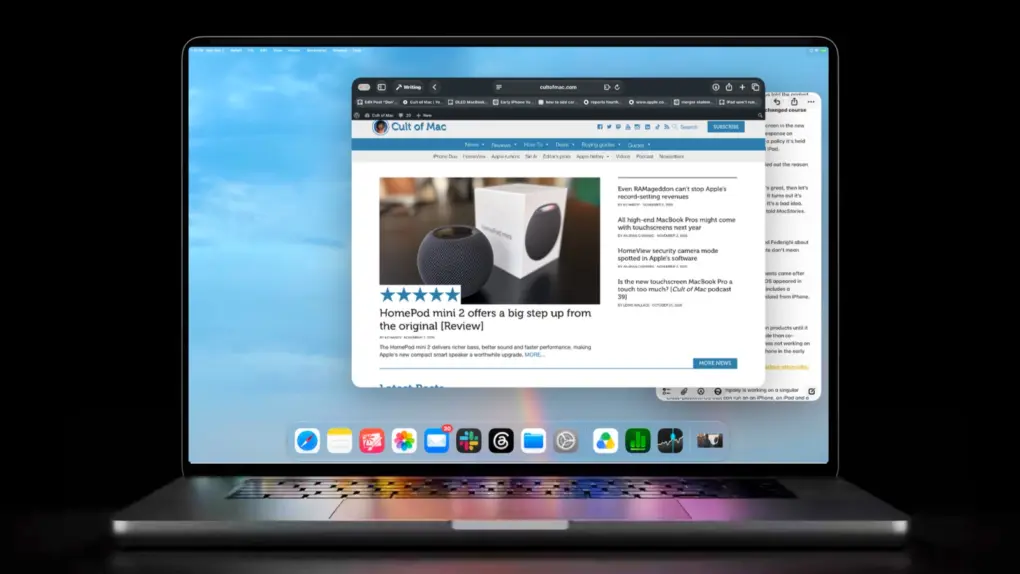
The new MacBook Pro with PROLED XDR Display offers a beautiful new display, a significant decrease in weight… and a touchscreen. Apple doesn’t emphasize this feature – if anything, Ternus himself actually downplayed it in a recent interview.
Nevertheless, the very first Mac with a touchscreen is a significant change in the company’s product lineup. And it caused an analyst on a conference call with Apple executives after the company’s latest earnings report to ask what the notebook means for the future of Apple operating systems.
macOS had to be modified with touch support, and the analyst wanted to know, “Should we anticipate further close linking of macOS and iOS features, maybe even pointing at some point to a single unified OS, either for simplicity or to reduce costs?”
CEO John Ternus was quick to throw cold water on the idea: “When we design the product, we’re looking at how can we make the best version of each and every product.”
In other words, he doesn’t believe that an operating system designed to run on a Mac or iPhone would be the best one to run on an iPad, and vice versa.
Ternus said the company prefers to create features that make its various types of computers work together better.
“We are very proud of both the Mac and the iPad, and I think what you’ve seen over the years is we really enjoy the ability to bring features and capabilities across the ecosystem, and create really compelling features that span between iPhone and Mac and iPad,” Ternus told the analyst.
One new product doesn’t mean Apple changed course
While it’s understandable that the touchscreen in the new MacBook Pro raises questions, Ternus’s response on Monday shows that Apple is sticking with a policy it’s held for years: it’s not going to merge Mac and iPad.
Apple software chief Craig Federighi spelled out the reason why in 2025.
“Someone said, ‘If a spoon’s great, a fork’s great, then let’s combine them into a single utensil, right?’ It turns out it’s not a good spoon and it’s not a good fork. It’s a bad idea. And so we don’t want to build sporks,” he told MacStories.
Apple devices borrow from each other
To be clear, the comments from Ternus and Federighi about keeping the various Apple devices separate don’t mean they won’t borrow from each other.
As proof, the software chief’s 2025 comments came after some of the multitasking features of macOS appeared in iPadOS. And now the OLED MacBook Pro includes a touchscreen from iPad and the Dynamic Island from iPhone.
Who can say for the future?
Apple is famous for denying it’s working on products until it announces them. There’s no better example than co-founder Steve Jobs saying the company was not working on a cell phone when it must have had the iPhone in the early stages of development.
Still, the idea that Apple is working on a singular cross-platform OS that can run on an iPhone, an iPad and a Mac seems far-fetched.

Ed Hardy has been writing full-time about tech for 26 years, and using it for much longer than that. His intro to Apple was a Macintosh SE/30 (which he still has), but now he uses a 13-inch iPad Pro as his primary computer.
That’s because he’s a “tablet first” type of guy. Rather than use a Macbook, he connects a keyboard case to the iPad. And instead of a desktop Mac, he connects his tablet to a 27-inch display and full-size keyboard. (So don’t try to tell him that everyone has to use a Mac to be productive.)
Before coming to Cult of Mac, Ed wrote for NotebookReview, TabletPCReview and Brighthand, as well as other sites.