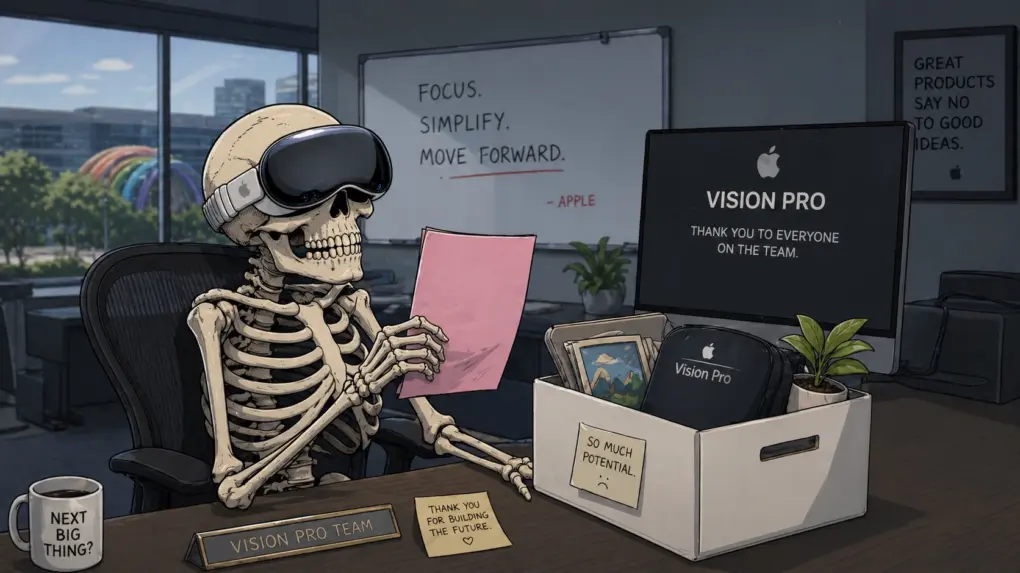
Apple reportedly stopped all work on future versions of the Vision Pro. The AR headset has struggled to go mainstream and may now have been dropped — possibly at the insistence of Apple’s incoming CEO, John Ternus.
Instead, the company is allegedly changing its focus to smart glasses that offer fewer features but are lighter and more affordable.
Apple might not see a future for the Vision Pro
Despite Apple’s efforts to drum up interest, Vision Pro remained a niche product. Analysts estimate that less than a million units have sold since the 2024 launch — and the actual number could be closer to half that.
On Wednesday, MacRumors reported that Apple pulled the plug: “Apple has apparently stopped work on the Vision Pro and the Vision Pro team has been redistributed to other teams within Apple.”
This probably doesn’t shock anyone. It’s widely known that the headset’s high price — $3,500 — limited its appeal to a narrow group of early adopters. Plus, its weight and limited battery life kept many away, as the headset is difficult to use for long periods.
And there’s the Catch-22 that often strikes new types of computers. The small number of users discouraged developers, and the resulting limited number of applications for the platform kept buyers away.
That said, Vision Pro has enthusiastic users, including the surgeon who uses one while performing cataract surgery.
A new broom sweeps clean
Apple CEO Tim Cook was reportedly a champion of the Vision Pro and visionOS. But he’s now a lame duck — he’s departing as head of the company at the end of the summer.
John Ternus, Apple’s upcoming CEO, supposedly opposed the development of Vision Pro. It may have been his decision to stop putting money into a project that’s seen little success.
A change in focus
This isn’t the first time we’ve heard that Apple’s interest in Vision Pro was waning even as it ramped up its efforts on a related product: smart glasses. Leaks and news reports suggest that Cupertino is actively developing these, with an intent that they be lightweight and more affordable, albeit with fewer features.
The first generation of these — expected to debut around late 2026 or 2027 — supposedly won’t offer any augmented reality features at all. Instead, they’ll depend on voice interaction to provide AI chatbot features thanks to the smarter version of Siri that’s in development. The smart glasses will also be able to take pictures, control music and podcasts, and more.
Further down the road, Apple will allegedly add screens and AR capabilities. But only when these won’t make the smart glasses too cumbersome and expensive. This will likely mark the return of visionOS.

Ed Hardy has been writing full-time about tech for 25 years, and using it for much longer than that. His intro to Apple was a Macintosh SE/30 (which he still has), but now he uses a 13-inch iPad Pro as his primary computer.
That’s because he’s a “tablet first” type of guy. Rather than use a Macbook, he connects a keyboard case to the iPad. And instead of a desktop Mac, he connects his tablet to a 27-inch display and full-size keyboard. (So don’t try to tell him that everyone has to use a Mac to be productive.)
Before coming to Cult of Mac, Ed wrote for NotebookReview, TabletPCReview and Brighthand, as well as other sites.