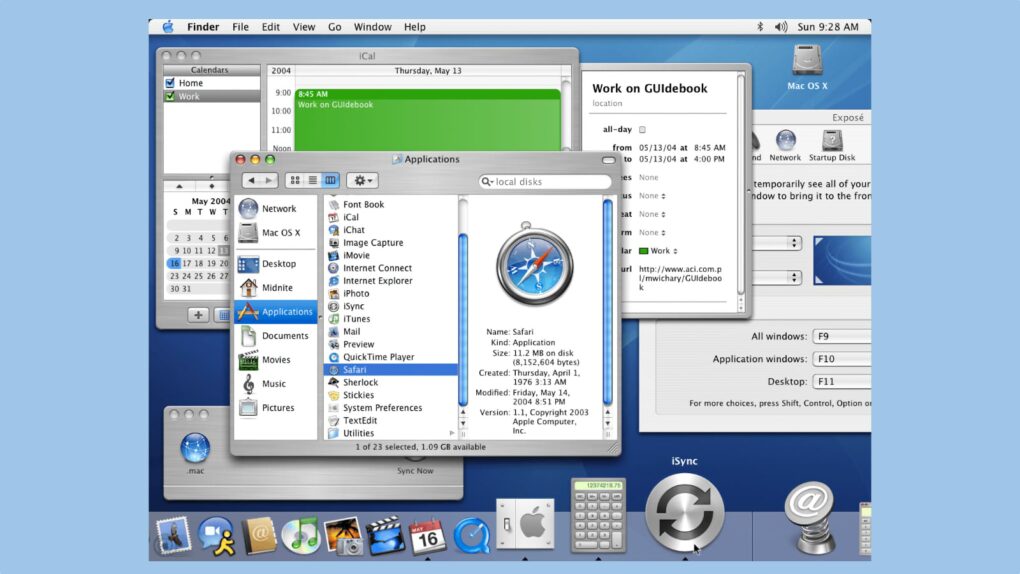
 October 25, 2003: Mac OS X Panther arrives on Macintosh computers, bringing several useful new features and making Apple’s Safari web browser the default for the first time.
The new Exposé feature in Panther (aka Mac OS X version 10.3) lets Mac users instantly view all open windows at once. And the new iChat AV allows people to talk with audio and video as well as text.
Mac OS X Panther: A minor improvement
By 2003, Apple had rescued the Mac from the brink of irrelevance with Mac OS X. However, the operating system still had plenty of rough edges to smooth out. Enter Panther, a release that made everyday Mac computing feel faster, smarter and more polished, while quietly laying the groundwork for features users still rely on today.
Its headline act, Exposé, offered an elegant solution to the growing mess of overlapping windows. Meanwhile, a revamped Finder, built-in file encryption and video chat pushed the Mac forward on multiple fronts. While not a radical reinvention, it was something just as important: proof that OS X was maturing into the foundation of the modern Mac experience.
“Panther sets the new gold standard for operating systems,” said Apple CEO Steve Jobs in a press release announcing Mac OS X version 10.3 earlier in the month. “With more than 150 new features, we’re delivering innovations today that will not be seen in any other operating system for years to come.”
Panther, which followed Mac OS X Jaguar (and preceded Mac OS X Tiger), wasn’t quite the major “must have” update that Jaguar had been. But I certainly found Panther to be very good, particularly with the addition of Exposé. (Exposé, Dashboard and Spaces all got rolled into Mission Control in 2011’s Mac OS X 10.7 Lion.) Greater compatibility with Microsoft Windows also made it easier than ever to work between Macs and PCs.
As far as Safari went, Apple previously included the browser as an update for Jaguar. However, Panther marked the first time Safari arrived as the default option on a new Apple operating system.
Why did it take so long for Apple to default to its own web browser? When Microsoft bailed out Cupertino in 1997, the deal mandated that Apple support Internet Explorer for five years. That period elapsed by the time Panther shipped.
Mac OS X Panther brings new Finder
Panther also brought a revamped Finder — complete with a brushed-metal appearance — that included a sidebar to make it easier to access disk drives and networks.
Other smaller, but still important, upgrades included the arrival of FileVault, which allowed users to encrypt hard drive data with 128-bit keys. The new OS also offered Xcode for developers and a simplified way to manage system fonts.
OS X Panther came with a price tag of $129. (Customers who bought a new Mac in the prior two weeks got the upgrade for free.)
Do you have fond memories of this particular Mac operating system? Tell us your favorite parts in the comments below.

Luke Dormehl is a U.K.-based journalist and author, with a background working in documentary film for Channel 4 and the BBC. He is the author of The Apple Revolution and The Formula: How Algorithms Solve All Our Problems … and Create More, both published by Penguin/Random House. His tech writing has also appeared in Wired, Fast Company, Techmeme and other publications.

2 responses to “Today in Apple history: OS X Panther claws its way onto Macs”
Any chance to run it on a modern iMac (or Tiger), maybe virtual???
Tiger 10.4.11 (even earlier) is Intel native, while both Panther and Jaguar exists Intel compatible somewhere within the cupertino labs, I havent seen it out in the wild.